Flight A921 was set to depart Hartsfield-Jackson Atlanta International Airport shortly after 2:00 PM on a mild spring afternoon in 2025. The terminal pulsed with the usual frenzy of air travel—suitcases clacking over polished floors, overlapping announcements echoing overhead, travelers crouched beside wall outlets like prospectors guarding gold.

At least, not at first glance.
Among the sea of hurried passengers stood a man most people barely noticed.
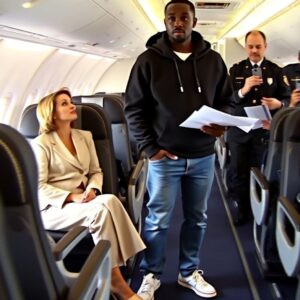
Daniel Cole wore a plain charcoal sweatshirt, worn denim, and scuffed white sneakers. There was nothing flashy about him—no tailored suit, no luxury watch, no obvious markers of wealth or authority. The only item that hinted at something different was a slim black leather briefcase, subtly embossed with the initials D.C.
In one hand, he held a cup of black coffee.
In the other, a boarding pass marked with a quiet but unmistakable designation: Seat 1A.
Front row. First class.
A seat that appeared under his name every time he flew this airline.
Because Daniel Cole wasn’t just another traveler.
He was the airline’s founder, chief executive officer, and majority shareholder—owning 68% of the company.
But on that afternoon, Daniel wasn’t moving through the airport as a billionaire executive.
He was moving through it as a Black man in a hoodie.
And no one around him knew the difference.
A Quiet Experiment
Daniel boarded early, exchanged polite nods with the flight crew, and settled into Seat 1A. He placed his coffee on the tray table, unfolded a newspaper, and took a slow breath.
In less than two hours, he would be in New York for a critical board meeting—one that would shape the airline’s future policies. For months, he had authorized a discreet internal audit examining customer complaints, reports of discrimination, and frontline staff behavior.
The data was unsettling.
But statistics only reveal so much.
Daniel wanted to see it for himself.
No assistants.
No announcement.
No recognition.
Just observation.
What he didn’t anticipate was how quickly the truth would surface.
“You’re in My Seat”
The voice came from behind him.
Sharp.
Demanding.
A manicured hand grabbed his shoulder and pulled hard.
Daniel jerked forward as hot coffee splashed across his newspaper and soaked into his jeans.
“Excuse me?” he said, standing instinctively.
A woman in her late forties stood over him, impeccably styled in a cream designer outfit. Her hair was flawless, her wrist heavy with diamonds, her perfume assertive enough to announce authority before words ever could.
Without hesitation, she sat down in Seat 1A.
“There,” she said, smoothing her jacket. “Problem solved.”
Daniel stared at her—not shocked by the seat theft, but by the ease with which it happened.
“I believe that seat is mine,” he said calmly.
She scanned him from head to toe, her expression tightening.
“First class is at the front,” she said slowly. “Coach is in the back.”
Nearby passengers turned. A few phones rose.
The air shifted.
When Authority Looks the Other Way
A flight attendant rushed over—Emily, professional smile already in place.
“Is there an issue here?” she asked, her hand instinctively resting on the woman’s arm.
“Yes,” the woman replied loudly. “This man was sitting in my seat.”
Daniel extended his boarding pass.
“Seat 1A,” he said. “That’s my assignment.”
Emily glanced at it briefly—barely a second.
“Sir,” she replied, voice tightening, “your seat is further back.”
“I’d appreciate it if you actually read it,” Daniel said evenly.
The woman scoffed.
“Let’s be realistic,” she said. “Do you honestly think someone dressed like that belongs up here?”
A teenage passenger three rows away hit the “Go Live” button.
Escalation Before Takeoff
A senior flight supervisor arrived—Mark Reynolds. He took charge instantly, without asking questions.
“You’re holding up the flight,” he snapped at Daniel. “Move to your assigned seat.”
“You haven’t verified my boarding pass,” Daniel replied.
Mark didn’t bother.
“If you don’t comply, airport security will escort you off this aircraft.”
The livestream numbers surged. Hundreds became thousands.
Comments flooded in:
Why won’t they read the ticket?
This is racism, plain and simple.
It’s 2025—how is this still happening?
Daniel remained composed—not because the moment didn’t sting, but because it confirmed everything he feared.
The Shift
Security arrived.
One officer, Lewis, took the boarding pass from Daniel and actually examined it.
“Seat 1A,” he said aloud.
The cabin went silent.
Mark frowned. “That doesn’t make sense,” he muttered. “Look at him.”
Those three words would later echo across headlines, court filings, and training seminars.
Daniel unlocked his phone and opened a secure application—one unavailable to ordinary users.
The airline’s logo filled the screen.
Then text appeared:
Daniel Cole — Chief Executive Officer
Ownership Stake: 68%
Employee ID: 000001
Access Level: Unrestricted
He showed it to the officer.
Then to Mark.
Then to the woman now sitting frozen in his seat.
“I own this airline,” Daniel said quietly.
The Internet Erupts
Color drained from the woman’s face.
“That’s… impossible,” she whispered.
Daniel met her eyes.
“Technically,” he replied, “every seat here is mine.”
The livestream exploded.
Within minutes, over 120,000 people were watching.
Daniel made several calls—on speaker.
Legal.
Human Resources.
Public Relations.
Suspensions were issued.
Terminations approved.
A press conference scheduled before sunset.
Then he turned back to the woman.
Her identity was already trending online:
Linda Harper — Senior Director of Brand Strategy
Public Advocate for Diversity & Inclusion
The irony was merciless.
“You speak about equality,” Daniel said. “But you couldn’t extend basic respect to the person in front of you.”
She began to cry.
“I didn’t mean it,” she said.
“Intent doesn’t undo harm,” Daniel replied.
Aftermath and Reform
The flight departed later—with a new crew.
Daniel finally sat in Seat 1A.
Within days, the airline announced sweeping reforms:
Mandatory bias training
Body cameras for cabin staff
Passenger advocacy protocols
A $50 million annual equity initiative
The video surpassed 15 million views.
Other airlines followed suit.
What began as an incident became a turning point.
One Year Later
Twelve months later, Daniel boarded the same route.
Same seat.
Different atmosphere.
He watched passengers of every background treated with the same courtesy, the same dignity.
He smiled to himself.
Because respect, he knew, was never about class or clothing.
It was about choice.
And the courage to say:
“Read the ticket.”
THE WEIGHT OF SILENCE
The plane took off forty-three minutes late.
Not because of weather.
Not because of mechanical failure.
Because no one knew what to say after the truth landed.
Daniel sat back in Seat 1A, hands folded, gaze fixed on the oval window as the runway blurred beneath them. The cabin felt unnaturally quiet—like a room where something sacred had been broken and everyone was afraid their breathing might make it worse.
No one apologized to him out loud.
Not immediately.
The flight attendants moved with exaggerated politeness now. Water refilled without asking. Blankets offered twice. Smiles strained and trembling.
Daniel declined everything.
He wasn’t hungry.
He wasn’t thirsty.
He was tired in a way sleep couldn’t fix.
The Woman in 1A (Now 4C)
Linda Harper sat rigidly in her reassigned seat, eyes fixed on the seatback screen she hadn’t turned on. Her hands shook in her lap. The diamonds on her wrist—symbols she had once worn like armor—now felt absurdly loud.
Every few minutes, she glanced forward.
At him.
The man she hadn’t seen as a man.
She replayed the moment over and over: the grip on his shoulder, the heat of entitlement, the certainty that she was right.
Because people like him don’t sit there.
The thought hadn’t arrived as words at the time. It never did. It came as instinct. As muscle memory. As confidence sharpened by decades of never being questioned.
Now the instinct sat in her throat like broken glass.
She opened her phone.
Notifications flooded in.
Colleagues. Friends. Journalists. Board members.
And beneath them—strangers.
Thousands of strangers.
Racist.
Fraud.
Fire her.
I hope she never works again.
How many times has she done this before?
Linda pressed her phone off and leaned back, breath shallow.
For the first time in her career, the narrative was not hers to shape.
Mid-Flight Reckoning
Halfway through the flight, Emily—the junior flight attendant who had barely glanced at Daniel’s boarding pass—stood near the galley, fighting tears.
She hadn’t meant to.
That was the truth that haunted her.
She had acted on autopilot. On assumption. On pattern.
When Mark had spoken, she’d followed. When Linda had asserted, she’d deferred.
And when Daniel had calmly asked her to read the ticket—
She hadn’t.
Emily stared at her hands.
I didn’t even look.
That realization hurt more than the suspension notice waiting in her inbox.
She thought of her training modules. The diversity videos. The quizzes she’d clicked through without really listening.
Bias isn’t always loud, one narrator had said.
Emily swallowed hard.
No—it was quiet. Efficient. Polite.
And devastating.
Touchdown
As the plane landed in New York, applause broke out—not celebratory, but awkward. Uncertain. A release of tension that had nowhere else to go.
Daniel waited until the cabin cleared.
He always did.
This time, it wasn’t courtesy—it was strategy.
When he stood, Mark Reynolds was waiting at the front of the plane.
The supervisor looked nothing like the man who had threatened him hours earlier.
Now he looked… hollow.
“Mr. Cole,” Mark said quietly. “I want to apologize.”
Daniel studied him.
“Go on.”
“I made assumptions. I abused my authority. And I—” His voice cracked. “I embarrassed the company.”
Daniel shook his head once.
“No,” he said. “You embarrassed yourself. The company just let you.”
Mark flinched.
“I’ve already submitted my resignation,” he added quickly.
Daniel nodded. “That’s your choice.”
Then he stepped past him.
The Press Conference
By the time Daniel arrived at headquarters, the lobby was surrounded by cameras.
Flashbulbs exploded as he took the podium.
He hadn’t planned to speak personally.
But silence, he knew, could sound like forgiveness.
“I did not board that flight to make a statement,” Daniel began. “I boarded it because I wanted to see the truth without filters.”
The room stilled.
“What I witnessed was not an anomaly,” he continued. “It was a system functioning exactly as designed—one that decides who belongs before it decides what is true.”
A reporter raised a hand. “Are you saying this was intentional?”
Daniel met her gaze. “I’m saying it was practiced.”
Murmurs rippled.
“The woman who took my seat believed she was entitled to it. The staff believed her. Not because of evidence—but because of appearance.”
He paused.
“If this can happen to the man who owns the airline,” he said quietly, “imagine how often it happens to those who don’t.”
The room fell silent.
Consequences
Within forty-eight hours:
Mark Reynolds’ resignation became termination.
Emily and two other attendants were suspended pending retraining.
Linda Harper was placed on immediate leave.
By Friday, her resignation followed.
Her carefully curated career collapsed in a week.
She released a statement—carefully worded, deeply apologetic, legally vetted.
Daniel didn’t respond.
Because accountability, he believed, didn’t need an audience.
The Messages He Kept
Daniel received thousands of messages.
Some were angry.
Some grateful.
Some heartbreaking.
One stood out.
My dad flies your airline every week. He wears hoodies because they’re comfortable. He’s never sat in first class even when he’s paid for it—he says it’s “easier not to fight.” Thank you for fighting.
Daniel read that message twice.
Then once more.
Six Months Later
Training rooms changed.
Policies changed.
But culture?
Culture resisted.
There were complaints. Pushback. Quiet resentment.
Daniel expected it.
Change always sounded like inconvenience to those who benefited from the old ways.
He visited flights unannounced. Sat in different cabins. Watched interactions.
Sometimes, he intervened.
Sometimes, he didn’t need to.
One afternoon, he watched a young flight attendant kneel beside an elderly man and say:
“Sir, let me double-check your boarding pass. I want to make sure you’re comfortable.”
Daniel smiled.
That was it.
Not accusation.
Not assumption.
Verification with dignity.
One Quiet Moment
Late one evening, Daniel stood alone in a hangar, watching planes being serviced under bright white lights.
Millions of people trusted these machines every day.
Trust was fragile.
So was fairness.
He thought back to the moment the woman grabbed his shoulder.
The anger hadn’t come from the act.
It had come from the certainty behind it.
The certainty that she didn’t need to ask.
That certainty, Daniel knew, was the real enemy.
He closed his eyes briefly.
Then turned back toward the terminal.
There was still work to do.
And this time, everyone was watching.